Susquehanna Shale Hills Critical Zone Observatory was established and funded by the National Science Foundation (NSF) from 2007 - 2020. We continue to strive to keep this field research facility in operation. Our research promotes the understanding of how a forested, first-order catchment of shale bedrock evolves over multiple time scales in a temperate climate.
More than six decades of data collection supports the legacy of the Shale Hills catchment as one of the world's best-monitored first-order watersheds. Located within the Penn State Stone Valley Forest, this experimental watershed has become a living laboratory for faculty and students across more than fifteen disciplines in three colleges and offers unique opportunities for research, education, and outreach.
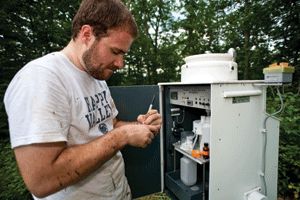
Designated as a Critical Zone Observatory (CZO) in 2007 with funding from the National Science Foundation (NSF), Shale Hills has hosted dozens of investigations of the structure, function and evolution of this first-order, forested catchment of shale bedrock typical of Appalachian landscapes. Investigations are supported by a "wired-up forest watershed" with ongoing measurements of soil moisture, soil gases, stream discharge, groundwater levels, precipitation, and radiative and turbulent fluxes of energy, momentum and CO2. Data from these instruments, spread across the catchment from valley floor to ridge top, are received on campus in near real-time. These data streams, many of which are more than a decade long, are supported by detailed surveys of vegetation cover, soil physics, chemistry and depth, and bedrock structure. Infrastructure at the site include power, fast internet access, an instrumented 30-m tower, a weir and multiple wells, both shallow (order 1 m) and deep (tens of meters). The site is supported by a multi-functional, high-resolution watershed eco-biogeochemicalhydrological modeling system developed at Penn State. Investigations at the site have explored how the fragile skin of the earth in which we live, or the critical zone, came to be, how it functions, and how it is responding to human activities and changes in the climate. The site is adjacent to the Shaver's Creek Environmental Center, enabling easy access for education and outreach activities, and for workshops at the Center's conference facilities.
"We emphasize quantitative prediction of Critical Zone creation and structure, focusing on pathways and rates of water, solutes, and sediments"
Contacts:
- Jason Kaye: Send email
- Ken Davis: Send email
- Brandon Forsythe: Send email
Science Questions:
How does water sculpt a landscape on shale bedrock?
What controls the hydrologic and elemental budgets of the catchment?
What are the rates and mechanisms of important hydrological, ecological, and geochemical processes?
Our CZO is a forested, first-order catchment on shale bedrock in a temperate climate.
Our research promotes understanding of how the forested catchment evolves over multiple timescales ranging from the meteorological to the geological.
 | Research |
 | Building upon the Past |
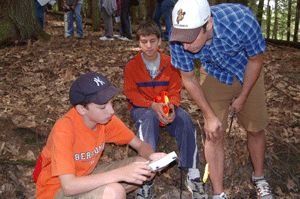 | Education and Outreach |
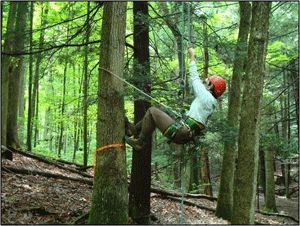 | Opportunities |